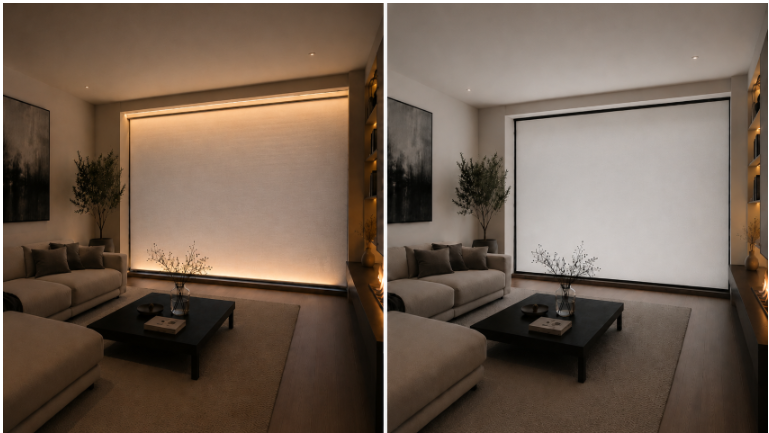
When choosing window coverings, a great deal of attention is often paid to colour, fabric and finish. What is less well known is that lighting also plays a significant role in the final result.
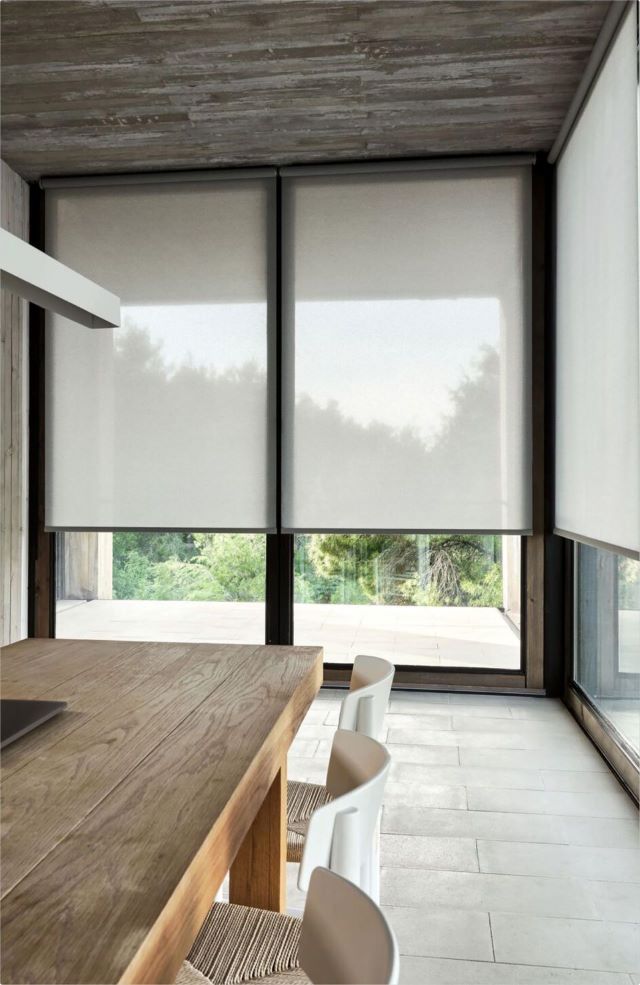
Roller blinds are designed to look sleek and minimalist. However, a roller blind remains a roll-up fabric system in which small natural ripples or minimal variations in tension are inherent to the product. Under normal lighting conditions, these are barely visible.
The effect of lighting on a roller blind is similar to that of raking light on plasterwork. A wall may appear pefectly smooth, but as soon as light shines across the surface, even the smallest imperfections become visible. The same happens with roller blinds.
That is why, when designing an interior, it is important to consider not only the window covering but also the placement and direction of the lighting. A lighting arrangement that works perfectly for a wall or piece of furniture is not always the most suitable choice when combine with a roller blind.
By matching the lighting to the chosen window decoration, you can avoid unwanted visual effects and maintain the sleek look for which roller blinds are so often chosen.